Chill Color - Paint by Number
- 4.7
- Rating
- 100.00K
- Installs
- Free
- Price
 Analysis by App-foxy
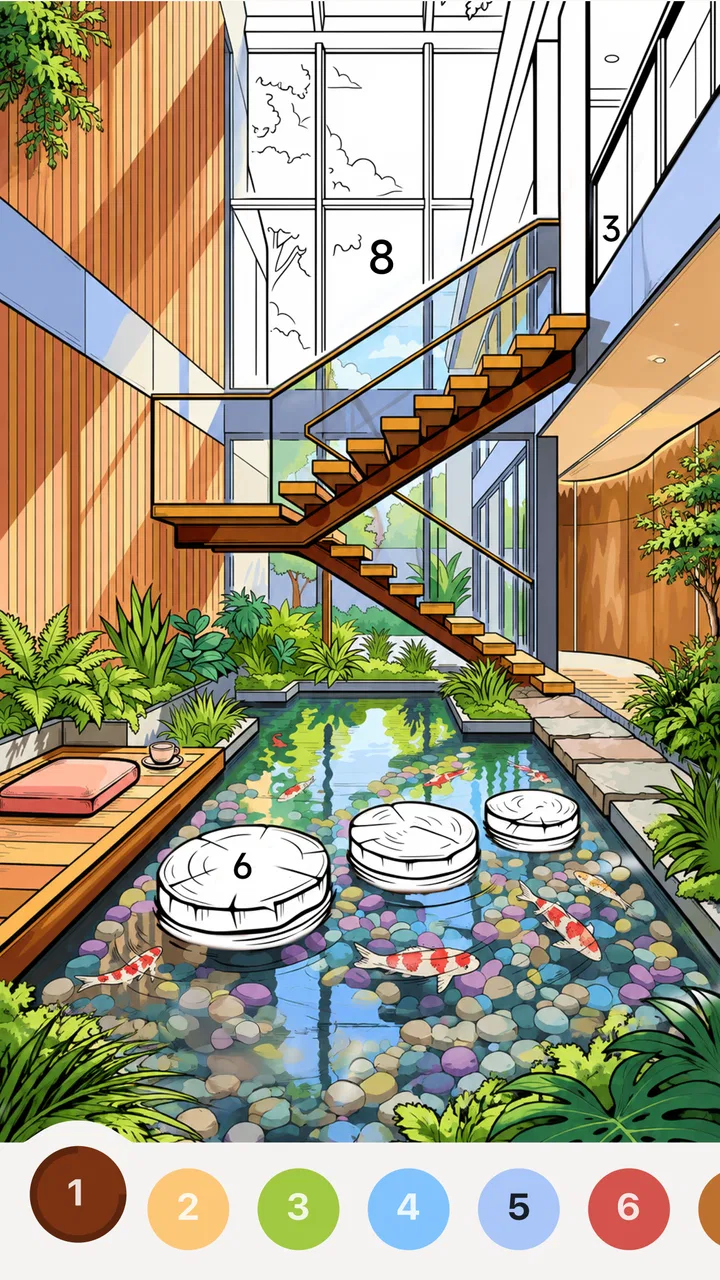
Chill Color - Paint by Number is the kind of board game I open when I want something gentle rather than competitive. Its focus is interior coloring: warm rooms, familiar objects, and quiet scenes that turn a small amount of attention into a finished picture. I found the appeal less in chasing a high score and more in watching an incomplete room gradually become inviting.
That makes it a useful choice for short breaks, especially when a traditional puzzle feels too demanding. At the same time, it is important to approach it for what it is. This is not a strategy board game with deep planning, and it is not a drawing tool that gives complete artistic freedom. The pleasure comes from following the numbered structure, choosing to continue, and enjoying the steady visual change.
How Chill Color turns a simple task into a relaxing routine
The game comes from Joyful Ark Studio and is free to play. It is listed for Everyone, which fits the calm presentation and straightforward activity. I could imagine using it on a quiet evening, during a commute, or while waiting for an appointment, provided I wanted a screen activity that asks for patience instead of fast reactions.
You May Also Like

 Blood Strike: 2.5 Anniversary
Blood Strike’s Loadouts Turn Every Drop Into a Tactical Gamble
A close look at Blood Strike’s custom loadouts: how fast access to signature weapons reshapes its battle royale rhythm, rewards preparation, and narrows the gap between fights.

 Pandora - Music & Podcasts
Pandora’s Music Is Easy to Start, but Harder to Recover
Pandora’s strength is its low-effort path from a seed to a station. Its weak spot is how much confidence it asks you to place in connection, setup, and quiet recovery.

 8 Ball Pool
 Is Built on Rivalries, Rematches, and Routine
A close look at the rivalries, rematches, shared routines, and unanswered safety questions that turn a quick pool match into a persistent mobile community.

 Samsung Music
’s Quiet Strength Is Playing What You Already Own
Its reach comes less from spectacle than from dependable access to a personal library. That simplicity is both the app’s strongest retention engine and its ceiling.

 AccuWeather: Weather Radar
AccuWeather Review: A Quick, Clear Forecast for Everyday Decisions
For everyday plans, the best forecast is the one you can understand quickly. AccuWeather makes rain timing, radar, and local conditions easy to act on, with a few trade-offs.

 Hill Climb Racing
Why Hill Climb Racing Still Turns Crashes Into One More Run
A tiny car, a bumpy hill and one more upgrade: Hill Climb Racing keeps resurfacing because its simple chaos makes every near-miss feel personal.
More From Our News Desk
View All News


The first goal is immediately understandable: complete the picture. That clarity matters because there is no need to learn a complicated ruleset before starting. A numbered color area tells me what to work on, and each completed section makes the room look more finished. The early moments therefore create a small but reliable loop: locate a color, fill matching spaces, notice the image improve, and move toward completion.
This simple goal also gives the game a softer form of challenge. I am not competing against another player, trying to beat a timer, or protecting a limited supply of moves. The challenge is mainly visual attention and persistence. Small areas can be easy to overlook, particularly when several details share similar tones or sit close together. Finishing a scene depends on noticing those remaining pieces rather than solving a difficult board position.
I think that is where the “board” label needs a little context. Compared with classic board games, this is closer to a structured coloring activity presented through a game-like progression. Someone looking for chess-style decisions, card combinations, or tactical surprises should choose a different category of experience. Someone who enjoys the satisfaction of clearing a visual task may find the format much more appealing.
Early goals are clear, but intentionally modest
During my first sessions, the strongest motivation was simply seeing a plain interior become warmer. The rooms provide a more grounded setting than abstract patterns because the finished result feels like a recognizable place. A chair, table, lamp, wall, or decorative object gives the coloring a sense of purpose, even though the underlying action remains uncomplicated.
The early goals work best for people who like visible completion. Every filled area acts as a small progress signal, and the whole illustration becomes easier to read as the colors accumulate. This is especially satisfying when I return to a picture after a pause and can quickly identify what remains. The game does not need a dramatic reward to make the next few minutes worthwhile; the changing image does much of that work.
One practical tip is to avoid treating every session as a race to finish. I got more enjoyment by completing a few color groups and stopping at a natural point, rather than tapping impatiently through the scene. That approach makes the game fit better into short breaks and reduces the feeling that a relaxing activity has turned into a chore.
Another useful habit is to scan the entire image before concentrating on one corner. Working only from the first visible area can leave isolated spaces behind, and those leftovers are often less satisfying to find at the end. A quick visual sweep helps me understand the layout and makes the final cleanup less frustrating.
Progress feels visual rather than numerical
Chill Color’s most convincing progress signal is the artwork itself. The room changes from unfinished to coherent, so I can judge advancement without needing a complicated dashboard. This is a good fit for players who prefer immediate feedback over long-term statistics. The picture shows me that my time has produced something tangible.
There is also a useful rhythm in alternating between large, obvious areas and tiny details. Filling broad sections creates a noticeable transformation early, while smaller objects provide a reason to keep looking once the main structure is complete. I found that switching between these types of tasks prevented the activity from feeling completely flat.
Still, visual progress has limits. It does not offer the same sense of mastery as learning a difficult rule system. I am improving my observation and patience, but I am not developing a strategy that can be applied to increasingly complex opponents. The satisfaction is closer to completing a page in a coloring book than winning a traditional board match.
The game’s reception suggests that this straightforward approach connects with many players. It has a 4.7 average from around 1.9 thousand ratings, with over 50 thousand installs. Those figures do not change the nature of the experience, but they do indicate that the quiet coloring format has found an audience beyond a handful of curious users.
The difficulty curve depends on attention, not advanced rules
I would describe the difficulty curve as gentle. The basic action remains accessible, and the game does not ask me to memorize elaborate systems before I can make progress. Difficulty comes from the density of the illustration, the size of the areas, and how easily a remaining section blends into nearby details.
That design makes the game approachable for casual players, older family members, and anyone who wants an activity without a steep learning period. The Everyone age rating also makes the overall presentation feel broadly accessible. It is easy to explain the objective to another person: follow the number and color the matching space.
The trade-off is that experienced puzzle players may find the challenge too light. If I am looking for increasingly demanding logic, time pressure, or meaningful consequences for a mistake, this is unlikely to satisfy me for long. The game’s calm pacing is a strength when I want to unwind, but it can feel underpowered when I want a serious mental workout.
For that reason, I would use it alongside rather than instead of a more demanding board game. A traditional puzzle app is better for testing deduction. A competitive board game is better for social tension and replayable decisions. A freeform drawing app is better when I want to choose my own colors and create an image from scratch. Chill Color occupies the quieter middle ground: guided, visual, and forgiving.
What keeps the routine going
The main retention pressure is the unfinished picture. Once a room is partly colored, the remaining areas become easy to notice, and I naturally want to complete the visual transformation. This is a modest form of motivation, but it feels less aggressive than systems built around countdowns, energy limits, or competitive rankings.
That gentleness is one of the game’s best qualities. I do not feel pushed to perform at a certain speed, and the activity can remain a background ritual rather than a demanding commitment. On a busy day, I can open it for a short session, make visible progress, and leave without feeling that I have missed an important event.
There is a downside to this approach: if the artwork itself does not interest me, there may not be enough pressure to bring me back. The game’s retention depends heavily on whether I enjoy the interior scenes and the act of completing them. Players who need strong unlock goals, competitive ladders, or a constant stream of new mechanics may find the loop too quiet.
I also think the lack of urgency changes how the game should be judged. It is not trying to create suspense. Its success depends on whether the pacing helps me relax without becoming dull. In my experience, it works best in ten-minute windows, when I want a clear beginning and end but do not want to commit to a full puzzle session.
Small workflow choices make a difference
A useful workflow is to start with the most visible color group, then move toward the edges and decorative details. The larger spaces quickly establish the room’s atmosphere, while the edge scan helps prevent the common problem of finishing the obvious parts and overlooking tiny sections. This is not a special power or hidden mode; it is simply the most comfortable way I found to work through a busy image.
I also recommend taking a pause before the final cleanup. When only a few spaces remain, repeatedly searching can become tiring because the visual contrast is lower. Looking away briefly and returning with fresh eyes makes those gaps easier to spot. That small habit keeps the ending from feeling like tedious pixel hunting.
For a shared family setting, the game could work as a quiet pass-and-play activity, with one person identifying the next number and another filling the area. It is not a multiplayer board match, so the social value comes from conversation and cooperation rather than turns, competition, or shared strategy. That distinction matters if a family wants an interactive group game rather than a calm side activity.
The current version is 1.0.1, and the game requires Android 6.0 or later. On a compatible device, the basic appeal should be easy to understand without a long setup period. I would still check the device requirements before planning to use it on an older phone, particularly if that phone is kept for occasional offline entertainment.
Who should play it, and who should skip it?
I would recommend Chill Color to anyone who likes paint-by-number activities, cozy room imagery, and low-pressure progress. It suits people who want to settle down before sleep, occupy a few spare minutes, or replace aimless scrolling with something that leaves a finished image behind. It may also appeal to players who enjoy tidying visual spaces and checking off small tasks.
It is a particularly good match for someone who finds freehand coloring intimidating. The numbered structure removes the pressure to decide what belongs where, while still providing the pleasure of choosing the next area to complete. In that sense, it offers guided creativity rather than open-ended creation.
I would skip it if my priority were competitive depth, elaborate unlock planning, or a strong difficulty climb. I would also choose a conventional coloring app if I wanted full control over palettes, brush styles, and personal designs. The fixed structure is precisely what makes Chill Color relaxing, but that same structure limits experimentation.
The free price makes it easy to try without a financial commitment. Even so, “free” does not automatically mean it will suit every mood. The real question is whether I want a calm, directed activity. If I am restless and looking for novelty every few minutes, the restrained format may feel repetitive.
My progression verdict
Chill Color succeeds when it treats progress as a visual journey rather than a contest. The early goal is clear, the picture provides constant feedback, and the difficulty stays accessible enough for relaxed play. Its pacing gives me room to stop and return, which is valuable for a game designed around peaceful moments.
Its limitations are equally clear. The challenge is based on careful tapping and observation, not deep board-game decisions. The motivation to continue comes mostly from completing scenes, so players who need elaborate unlock structures or escalating pressure may reach the end of their interest quickly. That is not a flaw in the concept, but it is an important boundary.
After using it, I see it as a focused relaxation game rather than a full board-game replacement. Joyful Ark Studio has kept the central activity approachable, and the interior setting gives the coloring a warmer identity than a collection of disconnected shapes. The best reason to install it is simple: it turns a few quiet minutes into visible progress without demanding much from me.
If that sounds like the kind of routine I want, Chill Color - Paint by Number is an easy recommendation. I would keep expectations centered on calm completion, not complex strategy. For me, that honest positioning is what makes the game work: it does not need to be more intense than it is to provide a pleasant, repeatable break.
FAQs for Chill Color - Paint by Number
01What is Chill Color - Paint by Number?
Chill Color - Paint by Number is a mobile application designed to offer a relaxing painting experience. Users can select from a wide variety of images and color them by following number guides. It's a perfect app for those looking to unwind and tap into their creative side without needing advanced artistic skills.
02Is Chill Color - Paint by Number free to use?
Yes, Chill Color - Paint by Number is free to download and offers a wide range of images to color. However, the app may include in-app purchases for premium content or features. Users can enjoy the basics without spending money, but additional content might enhance the experience.
03Does Chill Color - Paint by Number work offline?
Chill Color - Paint by Number requires an internet connection to download new images and updates. However, once images are downloaded, they can typically be accessed offline, allowing users to enjoy coloring without needing constant connectivity. This feature is great for travel or areas with limited internet access.
04Are there any age restrictions for using Chill Color - Paint by Number?
Chill Color - Paint by Number is generally suitable for all ages. The app is designed to be user-friendly and intuitive, making it accessible for both children and adults. However, parental guidance is recommended for younger users, especially if they will have access to in-app purchases.
05How does Chill Color - Paint by Number ensure user privacy?
The app prioritizes user privacy by adhering to strict data protection policies. It typically requires minimal personal information for account creation. Users should review the app’s privacy policy to understand what data is collected and how it is used, ensuring they are comfortable with the terms before downloading.
Pros
- Intuitive and user-friendly interface.
- Wide variety of coloring templates.
- Frequent updates with new designs.
- Offline mode for coloring anywhere.
- Relaxing music and sound effects.
Cons
- Contains in-app purchases.
- Occasional ads interrupt gameplay.
- Limited free templates available.
- Requires large storage space.
- No option for custom designs.

Chill Color - Paint by Number
Gallery